Memoirs
By
Alexandra Moore
Nee Shevaldisheff
9th September
1901 – July 2005
(Written circa 1990)
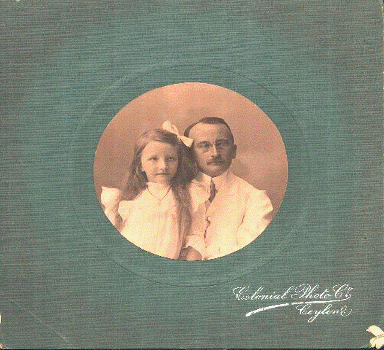
Alexandra aged 8 in 1909,
with her father
The information in these memoirs was gathered from notes
made by Alexandra Moore and additional
information collected by Susan Moore
and Bill Crozier in about 1990 when Alex was nearly 90. The information she
gave was recorded almost verbatim. On further research I have made a few
amendments to spelling of place names. I have also added pictures from archives
I hold and information gleaned from the Web appears as foot notes to the main
body of text. If members of the family have additional information please
e-mail me and I will try and incorporate it.
jwamoore@hotmail.com
Jonathan Moore
August 2005
My Story
I was born
in Odessa on the Black Sea, Russia, on the 8th
September 1901. I was christened Alexandra Shevaldisheff.
I cannot
remember very much of my early childhood but I have never forgotten one
incident. I must have been about 2 and a half. We were living quite near a
stable when one night the stable caught fire, there must have been quite a
number of horses there, but it was the dreadful crackling flames, the red glow
and the movement of red shadows on the ceiling of the room I was in which
terrified me and remains in my memory to this day. I must have been put by my
mother into another room and I suppose I went to sleep after my sobs of terror.
Soon after we this came to live in London.
My father had a job with one of the big tea firms and often went to Ceylon, Japan
and China.
He was a well known tea taster and a number of articles were written about him.
He could always tell which garden the tea came from and what the price was but
I shall come to that later. The climate in England did not suit my mother.
Before leaving Ceylon
she became very ill. A brother was still born and shortly afterwards Mother
developed or was diagnosed as having TB. From time to time we had to voyage to
warmer climates. My Governesses travelled with us, sometimes 2, one Russian or
French the other English, so that I would not miss out on my schooling.
Mother’s doctors thought that a sea voyage and going to a warmer climate would
be good for her. Anything was better than the damp and fog in London,
so we followed my father to Ceylon.
I am afraid
I forget how old I was when we joined my father in Colombo. I must have been about 4 years old
as my mothers’ illness lasted for quite some time. Since Daddy got to Colombo ages before we
did, we had everything organised for us. Our large cool bungalow was in a
street called Kollupitiya, not far from the ‘Galle Face Hotel’ and so along a very pretty coast road to
‘Mount
Lavinia Hotel’ where we lived when I was much older. Mother felt better for a
time and settled down to a quiet peaceful life. She could not join in all the
activities as for a time she had to lead the life of an invalid. I had a very
nice Ayah who looked after me and used to go out with me and my little white
dog in the rickshaw, a two wheeled, hooded carriage pulled by a man. My ayah
was Singhalese and used to spoil me! She would take me to play on the sands as
the hotel faced the Indian Ocean. Our bungalow
had a tennis court in the grounds which must have been lovely for my Father who
loved tennis. Mummy and I used to sit and watch. A friend of daddy’s used to
bring me sweets and sometimes toys to my great delight. Being an only child, I
was a bit spoilt – probably a little horror! When my parents thought I should
start to learn they employed a very nice girl who lived with us and taught me
to read and write in English. Mummy’s health deteriorated so Daddy rented a
bungalow at a hill station called ‘Bandarawela’ where the heat was not so
intense. It seemed to suit Mummy much better than Colombo. She and I, my ayah and teacher made
our home there. Daddy used to come for weekends to see us. I remember looking
forward so much to Saturday and crying like anything when Sunday night came and
he had to return to Colombo.
One weekend, just before my birthday, when Daddy arrived he asked me to put my
hand into his pocket which I did. Imagine my joy when I felt something warm and
furry, then two eyes looked at me and the little tan Dachshund started to
whine. I was delighted and proceeded to pull the puppy out of Daddy’s pocket.
We named her ‘Jalma’. She was such a pet and soon got used to us all.
Daddy and I
used to go for a walk, Jalma would come along too. We walked by the railway.
There was a little path there with quite large rocks. On one of these Daddy
carved our names with the sharp end of his alpenstock. I wonder if the rock and
the inscription are still there. Daddy was a great mountaineer and when in Switzerland on
holiday used to go off with his friends for days and climb, hence the
alpenstock which travelled with him everywhere. Mummy’s health got worse again
and after consulting specialists and her doctor Daddy decided on their advice
to send her to Davos-Platz where there was a sanatorium for TB patients. I
shall never forget how terribly sad Mummy and I felt at having to leave Daddy
behind. There were no planes then and it took 3 weeks from Colombo
to England
by boat. An hour before our boat sailed
he took us to our cabin and saw that we would be comfortable for the voyage. He
said goodbye and then went quickly off quickly as he could to the end of the
breakwater which was not far from the jetty in Colombo. He took up his position by the
lighthouse. As we steamed past, Daddy took off his topi – a white cork hat one
used to wear in a hot climate – and waved and waved until we had gone some
distance from the lighthouse and were in the Indian Ocean.
I shall always have that picture in my mind.
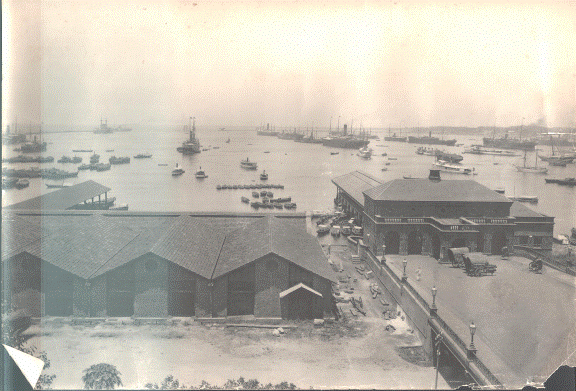
The Port of Colombo Circa 1912
Mummy and I
travelled extensively to Switzerland,
Italy, France and Germany. She was under different
doctors and went to the sanatorium in Davos-Platz. My father came on leave
then, so he and I as well as my governess lived in a little pension near the sanatorium
so that he could be near my mother. We saw her nearly every day. As soon as
Mummy’s health improved we rejoined my Father in Ceylon. I must have been 11 or 12
before we returned to Colombo. Daddy had sold the bungalow and moved to
Mount Lavinia Hotel.
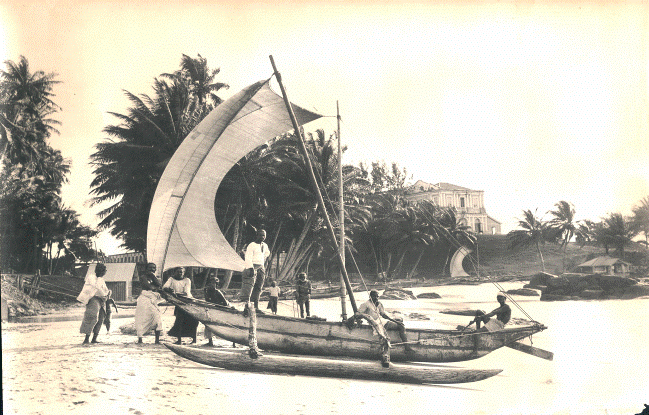
A view of Mount Lavinia Hotel 1912
He was sure
that the fresh air and sea breezes would improve my mothers’ health. The hotel
stood high up overlooking the ocean. There was a summer house above the rocks
where I used to sit when I was not busy doing lessons. I read “Uncle Tom’s
cabin” - a wonderful book about slavery in America. When I got to a sad bit I
used to cry! There was a turtle house, a white building, in the grounds of the
hotel where they kept turtles swimming in sea-water in a large tank. They kept
them for turtle soup!
We were
there in 1912. Mummy got a bit better but was far from well. I think it was a
year before we had to pack up and leave Ceylon, in mummy’s case forever! Daddy
had again to stay behind. We travelled quite a lot. We went to Milan,
Paris, and
Davos-Platz. However, at the TB sanatorium there the treatments mother received
were of little avail. As a last resort my father arranged for us to travel to Yalta on the Black Sea
where the climate is very good for TB sufferers. The late Tsar Nikolai 2nd
had his summer palace, Livadia, in Yalta.
I often used to see his daughters the four princesses, shopping in the town.
Mother’s
health became worse so my father had to get an extension of leave to be with
her. She died in 1915 on the 1st July aged 37. After everything was
arranged in Yalta we took mothers remains to Moscow where she was
buried. Daddy went back to Ceylon
for a few more years leaving me with my mother’s sister, Grusha, in Moscow. I lived with her
and her family and went to school with my cousins. In the winter we would go
skating before lunch. My school days were very happy ones except that sometimes
I missed my father very much.
One winter,
when it was especially cold I got a very bad chill – it turned to inflammation
of the lungs and I nearly died. The doctors did not think I would recover. They
had to shave all my lovely long hair off as it became matted as I was in bed
for such a long time, so that when I was convalescing I looked more like a boy
than a girl! To convalesce I was sent to live in Ashkabad in Russian Turkestan
with my father’s half sister and her children Tanya and Volodia. They were
older than me.
Tanya had
just returned from the Sorbonne and Volodia used to come and spend his holidays
with us. He was a soldier. I thought he was wonderful and had quite a crush on
him!
I made some
very good friends in Ashkabad especially with one family called
Voidato-Patchevich. Their daughter Tanya and son Iva
became my very great friends. In fact he and I were taken for brother and
sister. He was in the Russian Navy
as a
midshipman. He was to become Vice-president of the Conde Nast Publishing
Company in London and New York.
At the end
of 1916 there was so much unrest in that part of the world, in fact the whole
of Russia.
The Turkomanians revolted and went over to the Bolshevicks; these were not very
nice to know. Then the balloon went up and the Turkomanian natives of Russian
Turkestan all became fired with thoughts and deeds of revolution. Our life was
interrupted and in danger. My uncle stocked a cellar with water, food etc. and
when things became really bad we went into this cellar, staying there for about
a week. The cellar was very well hidden so we were not discovered. One day, to
our great relief, we heard voices in a different language. To our joy the
English had arrived to relieve Ashkabad with General Mallison as their
Commander. Part of three regiments came to help us, The Punjabis, The Hampshire’s
and the Warwickshire’s; the British mission to Turkestan.
There were a number of casualties among the troops and civilians. The
Turkomanians would climb trees and sit there waiting for their victims when it
was dark. All the troops came over the mountains from Meshed
in Persia.
(I once had an interesting book called “The Far Away Campaign” but
unfortunately I do not remember who wrote it). My uncle said that it would be
safe for us to get back to the house. You cannot imagine our joy when we knew
that we could get back into our house and feel safe! Since the troops did not
speak Russian, quite a number of us were asked to be interpreters. I was one of
them and used to help some of the officers and other ranks shop! At times it
was hilarious! They were in billets and barracks all over the town and some of
the medical officers and personnel commandeered a lovely house for a hospital.
The nurses were very few so they asked some of us, who were not trained, to
help with the wounded. I loved that job and used to take temperatures, make
beds and help with dressings. One of the doctors was an Indian, a tiny man,
very efficient and nice. Also two SRNs
were there. They were a very nice crowd and we all got on very well. There was
quite a lot of
fighting at
times. This was not pleasant, but seeing the British troops there and how
efficient they were, the Reds were soon beaten. Some fled to other towns. My
Uncle’s family and I made a lot of friends. They, the officers, used to come up
to the house. They were very welcome. Just before General Mallison and some of
his troops left, the girls who worked for him at the little hospital were
called to attend a farewell party. We were presented with gold watches. Mine
was inscribed - “to Miss A Shevaldisheff from the British mission to Turkestan 1918 with grateful thanks”. I still have it and
feel very proud when I look at it.
An
intelligence officer in the 19th Punjabis was a Major R.Teague
Jones.
We called him “Tiggi”.
He did not
seem to mind. Eventually he got us out with forged passports and papers –
actually 20 of us. I shall always be grateful to him. I had a very good friend
at this time named Valya Alexieva. She was a pretty girl. Major Teague Jones
fell in love with her and they were married in the Russian Orthodox Church
there. We all attended. It was a very impressive ceremony, so different from
weddings in England.
Crowns are held above the couple for ages by 2 male attendants standing behind
them. The singing was superb as there was a good choir there. Everything went
off without any incidents.
At that
time it was getting more and more difficult to get out of Russia. This applied to Russian
Turkestan too. Tiggi knew that the evil and the fighting were going to get
worse and we “White Russians” could be trapped. He got busy and organised an
escape for those who wanted to leave. He had an awful job of getting all the
names and numbers of those who wanted to go. He had help from some of the
inhabitants to do various jobs but it took a long time to organise it all-
false passports, occupations etc and all the time the Red menace was getting
nearer. After several months Tiggi said he had some news for us and could we
all assemble at a certain time in a hall. He informed us that everything was
arranged for us all to go by train to Krasnovodsk.
It was very
exciting to think of our escape. The train was not very long so the seats were
limited. About 20 of us with false names and papers prepared to leave having
said goodbye to our families. They stayed behind. When it became dusk the train
pulled out of the station en-route for Krasnovodsk on the Caspian
Sea. I met a newly married couple who had boarded the train at Tashkent. She was Russian
and he was an Englishman. They were so nice and took me under their wing. There
was also a good looking young man, a flying officer, who had his aeroplane with
him in an open goods truck. He was over 6 feet tall and had grey eyes and dark
hair. His name was Victor Clow.
He and I got on well together and had a lot in common.
We
eventually arrived in Krasnovodsk and here a boat awaited us with hardly a
light on board. We all clambered on board. There were some other people
travelling with us. After our papers were examined we were allowed to go around
the boat to find some sleeping accommodation.
The 20 of us all had to speak English as this is what our papers said we
were. It was all very well done. Thank goodness the Captain of the ship and his
crew were all pro Tsar and the Royal Family. Anyway on the sea journey there
were wonderful nights with the moon above (a very romantic setting) and Victor
and I got engaged.
The journey
across the Caspian Sea
took quite a while, but eventually we arrived at Baku.
We disembarked
and after a night at a hotel, we boarded a train which took us to Novorossiysk on the Black Sea.
From there we went by sea again eventually arriving in Constantinople (Istanbul). There were 3
islands about an hour from Constantinople by
ferry. The 3 were Principo (British), Halki (American) and Antigoni
(Italian). However because Principo was already full of refugees,
the Italians took us in and we stayed on
Antigoni. The Italians were very friendly and hospitable. We got to know the
officers quite well. They taught us Italian but not very well, but we were able
to say what we wanted in their language. We had a very amusing time.
Victor was
not very well but I cannot remember what the matter with him was. Anyway, he
was sent to England
in a hospital ship when he was able to travel.
He said that he would contact me once I got home and that he would
write. Tiggi helped me to get a job. My friend and I were put into the British
Embassy into an office where we put stamps on letters and sealed them. With
Victor away and only my job to do I began thinking it would be nice to see my
father, who was in Ceylon.
I had not seen him for 5 years. I asked Tiggi if he could get in touch with him
and so he wrote to the British consul in Colombo.
For some time I did not know what was happening, but one day Tiggi informed me
that he had managed to contact Daddy who had telegraphed him to say that he
wanted me to come to Ceylon.
Imagine my delight when a letter arrived from Daddy to say that he was well and
was longing to see m! I was overjoyed! We all left Turkey
and sailed for home and London. There I stayed with Tiggi and his wife in Philbeach Gardens
for a bit until I had done my shopping for Ceylon. That is where I saw Victor
again.
He came
looking like a city gent in a bowler hat, pinstripe trousers, umbrella etc. I
suppose I fell for him when he was in uniform and because I was away from all
my relations in Ashkabad. After he had taken me out several times I found we
simply did not have anything in common and I decided to call the whole thing
off. Anyway I was leaving shortly for Ceylon. Tiggi booked my passage. He
lent me the money for things I had to get and for my fare. (Daddy pain him
back). The day came when I left for Ceylon. I remember getting the train
from Paddington on my way to Birkenhead. I
felt so lonely when Tiggi and Valya left me. I got into my compartment and was
putting my suitcase on the rack when I heard a very pleasant voice saying “my
dear, you are very young to be travelling alone”. The voice belonged to a very
nice elderly woman who was to a very dear friend on the voyage to Ceylon. Her
name was Mrs Broadbent. She was going to visit her son who was living in Colombo.
Soon after,
I went into the corridor and was looking out of the window at the platform and
passengers when I saw three people coming along, 2 men and a woman, carrying
luggage. As I looked, lovely blue eyes met mine. He was fair with a very nice
smile. He was stocky not very tall, but oh so handsome. Something clicked inside
of me and I thought “oh boy, he is a darling. I hope that woman isn’t his
wife”. To my relief, as the guard blew his whistle, I saw this man kiss the
woman, shake hands with the man and climb onto the train. I was overjoyed and
hoped that he was going to Ceylon
on the SS Warwickshire, the Bibby Line
ship which
was to take us there. In fact he was and although I did not know it, he was to
become my husband later on.
It took 3
whole weeks to get to Colombo.
There was much fun on board. So many games to play – quoits etc. There was
dancing every night. Mrs Broadbent and I shared a cabin. The window faced the
deck so we were able to look out to sea. One night, as we neared Ceylon there
was a very bad storm. The ocean became very rough but that night t still
dancing. I had quite a number of partners. One of them was a Scot, Jock Bain. I
danced quite a lot with him. The ship rolled and pitched, in fact it was so bad
that we found ourselves sliding towards the rails!! In a way it was quite
exciting! My future husband always tried to be my partner for at games and
drinks. I think I only danced with him once or twice. I lead him a real dance!
In those days your Nan-Nan was an awful flirt.
After the
Warwickshire docked in Colombo,
relatives and friends were allowed on board. I was getting more and more
excited about meeting Daddy again after five long years. I stood by the gangway
with a very strongly beating heart and then I looked down at the bottom of the
steps and saw Daddy coming up followed by a very pretty girl with curly hair
and china blue eyes. Little did I know then that she was Daddy’s second wife? I
said goodbye to all my dear friends on board and left the ship. The hotel was
quite near the jetty so it was not far to walk there with a man carrying my
luggage – I had very little. I was so very happy that I was with Daddy again
but not so very sure about his young wife. I missed the life on board ship so
much at first and missed the friends I had made. I thought a lot about Mr
Moore, and wished I had not treated him so very badly.
A few days
passed and then one night we received an invitation to a Ball at the Galle Face
Hotel. It was from the Captain of the SS Warwickshire who wanted to meet all
his passengers again. I thought “oh how lovely, I shall see them all again”.
Jock and Mr Moore were there and lots of others I had met on board. Sadly, Mrs
Broadbent wasn’t there as she had already joined her son. We danced until the
early hours of the morning. It was a lovely night. Galle Face Hotel was huge
and very near the sea, so one stepped out of the ballroom onto a wide veranda,
down some steps and onto the golden sandy beach. The sky was a mass of stars.
All was over too quickly for me. I said my goodbyes, ignoring Mr Moore
completely.
I made
friends with Tra La La, a Mrs Leigh Clare with a small son called J.P. (John
Pierrot). She was very kind to me and when I met her at the ball saying goodbye
she said that if ever I wanted to come and look after JP, or if I were unhappy,
to write to her at once. She and her husband lived in Galle
where he was a very big noise working for the government in UK. I cannot remember what his job was. Mrs LC
was very eccentric but so very nice. I became restless when we moved to our
bungalow and said to Daddy one day that I wanted to train as a nurse in the big
hospital in Colombo.
Daddy had no objections so I wrote off to our friend Mr Cruickshank and asked
him to send me the forms etc. to fill in, which he did. But the stumbling block
was my step mother, who said that no daughter of hers was going to nurse so my
dreams were shattered. She was a most extraordinary woman and very unkind to
me. May be she was jealous of my youth. I began to hate her (god forgive me).
So in my desperation I wrote to my very eccentric friend Kathleen Leigh Clare
and said that my life was miserable in Colombo,
so could I come to Galle
to look after John Pierrot. A few days later a letter arrived to say that she
and indeed they all would be very pleased if I could come and look after JP as
my charge was called. Of course Daddy was rather upset that I could not get on
with my Stepmother but he thought that it would be a good thing if I could get
away and get a job. I had a very happy time with the Leigh Clare family and JP
adored me. He had a little mongoose called “Tikki” and we took him on a lead
all around the ramparts and down onto the beach. We both thought it was fun.
Galle is a very
old place and is rather beautiful with quite a lot of vegetation, palms
frangipani trees and others. The views were superb over the sea from all over
the verandas and windows. One day I began to think how badly I had treated
Teddy Moore and decided that I would write to him. I have never regretted the
decision. From then onwards an enormous correspondence started. I used to get a
letter about every five days or so. JP began to recognise the light blue
envelopes. He used to rush to me and give me my letter after giving me a big
hug. One day Teddy wrote a wonderful letter and proposed, asking me to accept
him. He said that he would come to Colombo
where we could get engaged. He also wanted to know what stones I would like in
my engagement ring. Of course I said “yes”. I think that I loved him from the
time that I saw him at the station boarding the train to Birkenhead.
By this time I was so very thrilled and excited that I wrote off to Daddy to
tell him.
It was very
sad saying goodbye to the Leigh Clare family. Kathleen cried as did JP. Teddy
arrived in due course with the ring – a sapphire and two diamonds. When it was
time to go to dinner at the Galle Face Hotel I walked with my hand well out in
front of me so that everyone could see my lovely ring. We had a very happy
time; I think it was about a week. When Teddy went back to India I felt
completely lost. We arranged that we would get married in May when he would be
in Colombo
again but little did we know that fate had something else in store for us. In
May, about the beginning of the month I received a letter from the Vicar who
was going to marry us to say that Teddy was in hospital with an acute appendix
and could I arrange to come to Calcutta.
I had to be in a tearing hurry as the operation was imminent. When I arrived in
Calcutta and docked after sailing up the Hugli River.
The
Reverend Cannon Parks was there to meet me looking up at the ships rails where
I was standing – “ I recognise you from your photograph”. Then I went down the
gangplank to meet the dear parson. He was so very charming and told me not to
worry. The operation had taken place 2 or 3 days before and Teddy was alright.
I went to see my darling. He was a bit sleepy – probably sedated – but he was
so very, very happy to see me. He brought his servant, Maila, from India and was
instructed by Teddy to go everywhere with me. I booked into a very nice hotel
and believe it or not, Maila slept on his bedding outside my door every night.
When I went to the hospital to see Teddy he came as well and escorted me when I
went shopping. Teddy’s wound would not heal in the heat of Calcutta
so it was arranged that we should go to Ghum,
a lovely hill station, I think not far from Darjeeling.
Oh! I
forgot to say that when he was stronger, before I took him to the hills, we
married in St Paul’s Cathedral in Calcutta.
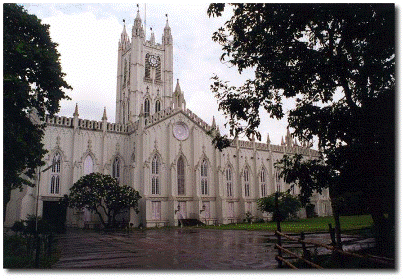
St Paul’s Cathedral, Calcutta
Two friends of Teddy’s gave me away as my
Father could not come to the wedding as he was in Colombo. When I was a bit late, a friend, a
nurse Henderson, was asked by Teddy if she would take my place. As a wedding
present Teddy gave me 2 lovely Borzoi wolfhounds.
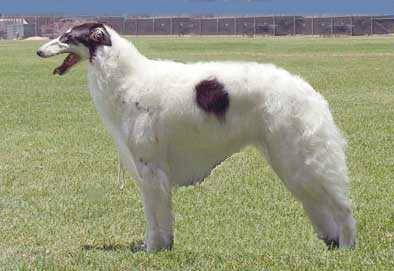
A typical
Borzoi
He knew how fond I was of dogs.
When I went riding in Ghum the 2 dogs followed me and people stared. I loved
the pony I had. It was so sure footed and obedient. Teddy’s wound started
healing well in the cool climate and soon it was time for us to go down to the
plains. Teddy was soon to start teaching at the University of Patna.
Ghum was a lovely little place, very hilly and the scenery was superb. From Darjeeling one could see the Himalayas
quite plainly. The track up to the hill station was very steep. I rode and
Teddy was carried in a “dhooly” ( I don’t know if I can remember the word
- a sort of hammock carried by
coolies). We went down to the plains and
found our bungalow made ready by dear Gobardhan. He was a wonderful servant.
The first bungalow we had was not very large but it had a big garden. The view
was lovely as we could see the Ganges from our
windows. There was plenty of room for our two dogs to romp about in the garden.
I soon
discovered I was pregnant. At that time the temperature in Patna was about 100. In the afternoon I used
to lie on the bed and gasp. A punka wallah sat outside the shutters of my room
and pulled the “punka”. Sometimes he would go to sleep so I shouted to him
“Punka Tanu” or “pull the punka”. The months dragged on. I must say that the
heat took a lot out of me. I was forever scratching with prickly heat. That was
not very pleasant. The doctor who looked after me was a woman, a Dr Stilwell,
and she got the dates all wrong as to when my Bunty was expected, so Teddy took
me up to the
Ranchi
Chota Nagpur
(Hills) about a fortnight before the event. Teddy used to come up and see me
from the
plains at
weekends. It was a long journey from the university at Patna. Anyway, I went up to Ranchi much too soon. I hated being away from
my Teddy for such an age. The days seemed endless. The nursing staffs at the
hospital were most unfeeling, very hard and did not show much interest or
sympathy when I felt miserable and had a little weep. Teddy used to come on his
motorbike. He would be covered in dust or mud when he arrived, the poor
darling. At last the day came when I started labour pains. The matron
telephoned teddy in Patna.
My little Bunty arrived after quite a hard long labour. She was lovely with
very fair skin and hardly any hair on her head. When Teddy arrived he walked
all around the cot and then held her in his arms. It was all so very wonderful.
He took me to Patna
about a fortnight after Bunty arrived, when it had become a bit cooler in the
plains. When we arrived the servants were all there to greet us. They wanted to
see the little “Missy baba”. I had quite a fright as Boris the Borzoi did not
like seeing Bunty in my arms. He snarled and bared his teeth. I was very
worried that he may do harm but when he got used to her it was perfectly
alright for him to be in the same room when I was feeding her. Kitty the other Borzoi, was more
understanding, being a woman! After a while we decided that the bungalow that
we were in was not big enough.
One next
door fell vacant so we moved in. There was much more room. Teddy was due for
some leave soon so when Bunty was about a year and a half we sailed to England. We
were on leave for about six months. We had a lovely time in England. We got
a very good nanny so we were able to leave Bunty with her and go places. We
took them with us sometimes. The weather was lovely, I remember, and we went to
Somerset and
saw Stratton-on-the-Fosse for the first time. Teddy loved Downside and the
village and surrounding countryside. He thought he would go and see the
headmaster, who was Father Trafford at the time. We would be home in again in
another 6 months or so on leave and he was interested in a job after that.
Father Trafford said to come and see him again on our next leave as there may
be a vacancy then. We were expecting another baby but it was early days yet. It
was so interesting watching my Bunty. She was so good and hardly ever cried at
night. Mary the Ayah looked after her. Our servants were a mixture of races. Some
were Indian, some from Nepal.
They were a good lot but a thieving one. I had to lock all the food in the
larder and give things to the cook every day. The milkman never milked the cow
into one of his utensils but into one of ours. I used to watch him from a
window upstairs to see that he did so.
It was a
funny life. There was a very nice club in Patna
where I played tennis and in the evenings we used to go there. I danced
sometimes with Teddy but he used to love playing snooker. We had quite a number
of friends whom we met there. Then there were dinner parties etc. and
Government House functions. One had to buy all the dresses for these occasions
in London and sometimes in Calcutta. I used to be thrilled when I saw a
Lancer arrive on horseback with an invitation for us to a ball at Government
house. They always look so wonderful in their uniforms and were very good
looking men. Once again the time arrived when we departed for England. The
ships in those days were small compared with the ones we have now but were very
comfortable and the food was always very good. When Teddy and I went to dinner
in the evenings, topaz, an Indian who looked after the baths, would look after
Bunty. Her cot was attached to the bottom bunk. It was quite deep so that a
baby could not fall out so was quite safe. There was so much activity on board.
We played all sorts of games. I loved deck quoits. At 11 a.m. every morning the
steward used to bring cups of steaming beef tea with biscuits while we all sat
on deck in our deck chairs. What a life!
Travelling
back to England
was a Lord Allenby
whose cabin was opposite ours. He took a great fancy to Bunty and made friends
with her. She used to gurgle and smile at him. By then she knew a few little
words. On arrival in London
we stayed at the Regent Palace Hotel
and after a few days we thought we had better go to an agency and get a nanny
for Bun. We could not leave her alone at the hotel so we could not go out. So,
off we went to Mrs
Boucher’s Agency. Our luck was in.
When we explained to the woman there our plight she said she had just
the right person to take charge of our baby. A woman called Mrs Gidney wanted
the job for about 5 or 6 months before she joined a family with children when
they returned to India.
It just suited us. She came for an interview at the hotel. We got on very well.
She was a widow with two grown up sons. We employed her. We never regretted
this step. She was wonderful and Bunty took to her at once. Teddy contacted Father Trafford at
Downside ( http://www.downside.co.uk/ ).
He said there would be a vacancy just for a month for a maths master and could
Teddy come there to see how he would get on. Since Teddy was employed by the
Indian Government he had to get permission from them to see if he could work
there for a month and keep his University post as professor at Patna. They said yes and we were very
pleased. So we moved again, this time to Stratton-on-the-Fosse. There was a
very nice house belonging to the school so we took it. It was lovely living in
the country for a bit. People were very friendly there and we made a number of
friends. Some of Betty’s relations were living there, the Watts’,
the Roach-Kellys’ and others. When the month was up we left
Stratton-on-the-fosse and returned to London.
Before leaving Teddy spoke to Father Trafford about coming to teach there at a
later date. On our return to London
in late 1924 Teddy and I went home hunting as we wanted to have a flat of our
own. We had become a bit tired of living in hotels. As luck would have it a
flat in Baron’s Court was vacant and to let. We looked over it and decided to
take it. It consisted of a hall, drawing room cum dining room, bedroom and a
basement which had two rooms and another bathroom. The kitchen was off our
bedroom, extraordinary! – but it did not worry us as it was only for a short
time. We moved in. Mrs Gidney used to take Bunty in her pram around St.Paul’s
School. Now it is not very nice there. It has many more houses and is near Hammersmith Bridge.
I was not
feeling very comfortable with my pregnancy but felt well. We were expecting the
baby on St. Patrick’s day but he arrived a few days later on 21st
March 1925. The night before he was born Teddy and I decided to go to the Ideal
Home Exhibition. We went by bus. I walked all over the exhibition and felt
absolutely fine. My little bundle arrived just after midnight. We were lying in
bed listening to the Savoy Orpheans
with earphones on. Teddy woke Mrs Gidney up and ran in his pyjamas for Dr
Stafford who was my doctor and lived very close by. When it was all over Teddy
looked at Pats in the cot and said “Good Heavens! Paderevski”
because of the nose. Next day and back home Teddy’s brother and his wife came
to see Patrick. Bunkett was so sweet with her little brother and played with
him a lot, touching his little hands and feet. After about a month or two (May
1925), we said goodbye to our flat and London
and went back to Patna.
On our
arrival Teddy heard that he had to go and take a Headmaster’s post in
Muzaffarpur across the River Ganges. The headmaster there was going on leave.
We moved there and I managed to get a very good ayah for the children. She was
Singhalese. The bungalow was in the grounds of GBB college – no where near the
river. There was a very nice little club in the town where we used to meet all
our friends. We loved it in Muzaffarpur as it was more countrified, no
Government House, not too sophisticated, just a very nice friendly place. We
met and became very friendly with J.H. Walton. He and Teddy were Masons and had
a lot in common. He was a big noise in the Pusa Agricultural college.
Pusa was not very far from Muzaffarpur. We used to go over to dinner with John
Hugh and once we arrived there we found Maudie, his sister, had arrived from England and was
helping JH to entertain and look after things in the home. We became great
friends. She was a very nice woman, a very good cook and very clever. We met
Primus Muntz his wife Gracie and younger brother. They were great friends of
the Waltons’. Our life there was very happy and I believed Teddy liked it
better than Patna.
He liked the Indian Students better and found them more interested in learning
than taking part in politics. While we were in Muzaffarpur, Mrs Gidney, our
nanny and friend came out to look after Patrick and Bunty. It was so lovely
having her with us. She was such fun and very good company. We were all so
happy together.
After about
18 months we returned to Patna
to a very nice big bungalow near the river. Time passed so quickly that before
we knew where we were, Bunty was going to be 7 years old and Patrick, five and
a half. We sat down and thought about our future an awful lot – whether we
should stay on or pack up and return home. It would have been very bad for
Bunty to stay in India
as she was getting very pale and had lost weight. We wanted to be together
without separations so Teddy retired long before he was supposed to leave India for good.
Students and every one of our dear friends were so sorry to see us go. We
sailed soon afterwards with old Gobardhan, our servant, sitting and crying. As
the ship sailed we threw our topi’s into the water and saw them floating away.
It was a very sad moment for us both. India had become home to us. We
returned to England
in 1931 and so ended another chapter of our lives.
First stop London, to the Regent
Palace Hotel where we lived with our children and Nanny. Teddy contacted Father
Trafford and went down to Stratton to see him. He was very pleased to tell me
on his return that he had been offered a job at Downside as senior Maths Master
and with it a house in the village. After a whirl of shows and dinners at super
restaurants etc., we left for Somerset
to a very new life, one with a nanny, cleaning woman, and me as cook. In fact
our first house was a bungalow in Holcombe. I was getting more and more
desperate about cooking so we wrote to Maude Walton to ask her if she would
like to give me a hand and teach me. She was an absolute brick and came from Eastbourne and stayed with us for 8 or 9 months. What a
friend to have.
Epilogue
1939- 45
war
War role
Teddy’s
death
The Royal School,
Bath
Cicely and
J
Old Meadow
House, Roehampton
Malaya – 1960 – 63
1966 Meadow
house/ Copse Hill
Rusbridger
Gundleton
Old
Alresford house
Quinta
Bibiliography:
Author: Teague-Jones, Reginald, d. 1988.
Title: The spy who disappeared : diary of a secret mission to
Russian Central Asia in 1918 / by Reginald
Teague-Jones ; introduction and
epilogue by Peter Hopkirk.
Published: London : V. Gollancz, 1990.
Description: 216 p. : ill. ; 24 cm.
LC Call No.: UB271.G
Dewey No.: 327.12092 20
ISBN: 0575047852 : L14.95
Subjects: Teague-Jones, Reginald, -- d. 1988.
Spies -- Great Britain -- Biography.
Soviet Union -- History -- Revolution, 1917-1921.
Other authors: Hopkirk, Peter.
Control No.: 71.G
WARWICKSHIRE (Br) 50.1 1902
Passenger liner/Cargo liner
Bibby S S Co Ltd, (Bibby Bros & Co, managers)
G720 (5S) A 16 Apr. 1904 12x10
58/5120 (5) B 16 Apr. 1904 Microfilm copy negative of G720.
58/51521 (5) B 16 Apr. 1904 Microfilm copy negative of G720.
P14958 (4S) B 1904 At anchor. A copy of a Gould photograph not
in the Collection. As a passenger liner.
P14959 (3S) B 1902-1928 Under tow, as a passenger liner.
P14960 (6P) C 1927-1932 Under way as a cargo liner.
P14961 (3P) C Jul. 1929 At moorings, as a cargo liner. Unsharp.
P30359 (7P) B 13 May 1925 At quayside, Royal Albert Dock,
London, as a
passenger liner.
P30360 (3P) B 26 Sep. 1928 At moorings, Port
Said, after
conversion to a cargo liner. Slightly distant.